Friday, December 4, 2015

Moving Around San Blas

After our first night in the Swimming Pool, Sundowner left.  We still had Gris-Gris, Runner, Hiatus, the Dragonboat, and a few other friends around.  Everybody is our friend as we feed the anchorage when we have a good day fishing.  


The Girls

The Girls


It was a little windy, the surf was up – so we couldn’t “get outside” to the good fishing, but we needed our daily diving session.  So we did a small dive inside the reef. Then we explored BBQ Island and decided to let the Kuna cook lunch for us.


The beach

The beach


Days full of simple living and no schedules.  Nights spent watching fish, chatting, and enjoying good wine. 


Then it was time for Teena to get back.  So we picked up our anchor and sailed to the East Lemmons. It wasn’t much, but it was sailing – finally. When we arrived at the East Lemmons we dropped anchor and I noticed a familiar boat in the anchorage – a captain that I’d met and become friends with in Cartagena.  Andres. Teena made it clear she wanted to party, and with Andres and crew – there’s always a party. 


So then night began.  We partied and ate with Andres and his crew – the group consisting of almost twenty people.  The girls danced and Andres gave salsa lessons.  I drank and laughed and did my best to make jokes in Spanish.


Suddenly we were out of beer.  There was beer on an island about two miles away.  But it was midnight.  The good news is I had the latest charts on my iPad and with Andres holding the iPad up front – I was able to steer the dinghy through the black night and around the myriad reefs to relative safety and cold beer.  It was a first, and we made people happy.


Teena was out early the next morning – heading back to Mexico.  After she left I was back asleep.  Then it rained.  So I  read.  We all relaxed as it rained and filled our tanks.  The real downside of rain is that we get no solar to charge our batteries.  And with another two people on the boat, we use a ton of energy.  So we were out of energy.  Naturally, when I pull out my Honda generator, it doesn’t start.  As if I was looking to compound the issue, now the pullcord breaks.  Have to take it apart, the girls help, we fix it and get it running to recharge our batteries.  It takes a few seconds to type that, but it took us hours to get it done.


We decide to stay around the East Lemmons waiting on news about my saildrive parts.  Naturally it doesn’t come (I’ve come to believe the guy I’m sourcing parts from borders on mentally handicapped).  I decide to not rush.  I decide to not worry.  Worst case scenario I’m returning home for Christmas and can pick up the parts then.


More charter captains (and good friends) come and go.  By day three in the East Lemmons, we’ve met almost all of my charter/backpacker buddies from Cartagena.  It’s good to know people. 


During this period I’m losing my mind.  There is very little diving in this area.  It’s raining.  My boat is broken.  I’ve killed a few good books.  But Mike takes me to a spot he knows.  He shows me a Dog Snapper hole, tells me it’s at 50 feet – a fair freedive when you’re hunting Dog Snapper (the tactic is to locate them, feign disinterest, dive to the bottom, sit there until curiosity gets the better of them and they approach you, hoping that happens before you need to breathe). 


The spot is a few large coral heads that are in a channel and connect to a reef wall.  The spot turns out to start at 45 feet and then drops another thirty feet before it hits the ocean floor.  So.  That’s beginning to get into the depth that I want to have a safety watching me.  If I sit on the ocean floor and a Dog Snapper circles just out of range – I have the tendency to forget that I need to breathe.  I set a mental depth limit at 55 feet, which would serve as my “bottom limit” – unless there was a great fish just two more kicks down


At 55 feet, with no sun and 20 feet of visibility I perched behind a coral head.  Waiting.  Concentrating on relaxing my muscles.  A fish circles just out of visibility.  The contractions start.  I run out of air. 


The surface.  Breathing. 


On the surface, Mike asks if I found the spot (the visibility made it impossible to locate the spot from the surface).  I tell him yes.  He asks if there were Dog Snapper there.  I told him no.  He says – they may be deeper.  I reset my depth limit to 66 feet on my dive watch and make the dive. 


Naturally I was more than a few feet away from where I wanted to be when I finally made it into the gloom and found the coral head.  More oxygen wasted as I swam along the bottom toward the coral head.  Finally there I headed down bit further.  My depth alarm went off.  66 feet.  And here come the Dog Snapper. 


The school stayed on the edge of my vision.  A good-eating size Dog Snapper gives me a broadside shot.  I take the shot, hit him well, and he slips under the coral head.  At 70 feet.  Already most of the way there, I descend further and untangle the fish and bring us both to the surface.  A lot of work for an unexciting fish.  He didn’t even make it into a picture. 


But we ate ceviche that night. 


And I slept well. 


The next post here will have bikinis and fish.  Which is why you’re all here.  So stay tuned.


Moving Around San Blas

Wednesday, December 2, 2015

Cruising San Blas

Where to begin. 


The issue is connectivity.  I can’t post regularly, we’re blowing through data, and the posts stack up.  2/3 of our electronics are acting funny.  The other third lacks enough antenna to receive signal here… So, bear with me.  Getting connected, right now, is frustrating stuff.  And one of my new things is avoiding frustrating stuff.  


Onwards. 


So much has happened.


Teena finally made it onboard.  She was the final crew addition, and with her onboard the only thing we needed to figure out was the saildrive issue.  Did we figure it out? Probably.  Did we fix it? No.  But we did pull it apart (including making a special tool – thanks Volvo Penta – to remove the offending part) and get our hands on the broken parts.  Mike is a remarkable human being, and incredibly generous with his knowledge and time.  That’s the moral of this story. 


What caused the failure?  No idea.  Not even the boat-fixing-stuff God Mike had an explanation that we believed was 100% correct.  The truth?  If we can’t isolate the cause – it matters very little.  The remaining issues: finding the part, getting a fair price for it, getting it to us, and then (finally) installing it.  Continue mission.


As far as locating the part:  I am aware of a mechanic that claims to have my Volvo Penta 120S saildrives in his shop near here.  If that’s the case, I may be able to get a good deal on the entire saildrive and simply poach the part I need – which would leave me with a ton of spare parts for the next (inevitable) saildrive oops. 


Cruising San Blas


So.  Then it was about limping to some other anchorage so that we could wait for my saildrive-parts info in a place that we all enjoyed.  Spearfishing the outer reef in The Swimming Pool was the entire reason I came back to San Blas – so that’s where we headed. 


To get out of the tricky anchorage we were in (Yansaladup) with only one engine could become catastrophic quickly.  So we strapped the dinghy to my starboard hull and used that to get us up to speed and maneuver.  It worked wonderfully.  We have it down to an art now.


Dez fishing

Dez fishing


There was wind on the nose as we headed to The Swimming Pool.  This is par for the course onboard NOMAD – wherever we go, the wind decides to work against us.  So the going was slow.  We averaged about 4 knots, and when we arrived we put Ana back in the dinghy to help me maneuver around the shallow spots and patch reef at the entrance to The Swimming Pool. 


Dez catching fish

Dez catching fish


As we entered, we found The Swimming Pool full.  And since I like my space, we pulled far into a cut and dropped the anchor in a spot that most wouldn’t.  


Friends in The Swimming Pool

Friends in The Swimming Pool


Having confidence in your charts and your ground tackle makes these maneuvers possible.    It was tricky and I wasn’t beyond setting an anchor alarm. 


Sundowner, who we’d come to know online but not yet in person, was in the anchorage with their friends.  Of the other boats anchored around, I knew a few.  I made the rounds and said my hello’s.  It’s nice to feel welcome, to feel a sense of returning to a familiar place with familiar people.  Especially when the people are as generous and giving as the cruising community. 


Naturally, Sundowner was leaving the following day so we wouldn’t get to spend too much time with them this time ‘round.  So we did what we always do – drink and dive and socialize and laugh and eat. 


The surf was pounding the barrier reef, so “getting outside” wasn’t a reality.  We stayed inside and poked around some interior caves.  There’s a swim-through that provides some excitement and can be quite challenging when there is current.  To get through the swim through you have to be able to swim underwater for at least 45 seconds, sometimes upwards of a minute.  Not a huge deal, but enough. 


In the caves I saw a massive Goliath Grouper – which are fair game here – but he evaded me and never showed himself again.  He was over 100 pounds and likely would have pushed 200 pounds.  Not a huge specimen for the Goliath’s – but I consider landing a fish like that an achievement.  And I would have shot him as we had enough boats anchored around us that none of the fish would have been wasted.  But, alas, he was savvy.  Then Ana and I dove some patch-reef inside the barrier reef, but inside a channel. 


No other fish showed, and with three crew (including a chef) that wanted fresh fish – I was forced into Plan B.  Plan B: shoot Ocean Triggerfish.  I can almost always find them, they are tasty and have a great texture.  The only issue with the Ocean Triggerfish is what a PITA they are to clean.  Their skin resembles armor and dulls any knife, without fail. 


Triggerfish in the dinghy – we retired for the evening and put on our drinking pants and our fish lights. 


Ana is always swimming

Ana is always swimming


Shortly we were watching clouds of baitfish around the boat and a bit later the Barracuda, Tarpon, and turtles came in.  A wonderful substitute for TV.  The fish light gives us the excitement of seeing both the large and small ocean-creatures of the night.  All night we talked and joked and drank.  The night regularly pierced with cries of “Look at that!” and “There’s something else huge!” or “Come look, quick!” .  


The fish-TV programming was topnotch onboard NOMAD. 


Cruising San Blas

Tuesday, December 1, 2015

San Blas!!

Sunrise.


French pressed Colombian coffee wafted through the boat and coaxed me out of bed.  The boat slowly rocking, the movement almost imperceptible.  The girls were up and whispering on the deck, I heard them giggling.  Up.  Coffee.


I did a check of everything as I drank coffee and wiped the sleep from my eyes.  Engine room.  Oil and coolant and belts all checked out.  Power.  We had plenty of energy.  Water.  We were eating through our water rather quickly.


No headache this morning.  I thanked God for that and then wondered what God I should be thanking for a hangover-free morning?   The night before included champagne, good whiskey, and cold beer – all before sunset.  This morning could have been worse.  


San Blas!!


I started the engines and put Ana and Des on the bow to help pull anchor.  We were under way in 10 minutes.  I hailed our neighbors on the VHF and wished them fair winds.  They responded warmly.  Then I heard their radio chatter switch to the nuts-and-bolts as their little cruising group prepared to pull anchor and head to Colombia.  Then we switched our VHF channel to 72, and it started to feel like I never left San Blas.  Maybe Colombia was just a hot dream.  It was time for the morning net – I put NOMAD on autopilot, left the girls in charge and went below to play with the SSB.  We checked in on the net and caught our friend’s positions in the islands.  I was officially back.  People welcomed us back.  It felt good.


No wind.  Motors on and chugging through the interior of the San Blas islands. Heat.  Blinding sunlight.  Rolling waves and the sunlight playing games as it broke and twisted and reflected back at us under the surface.  Fishing lines out.  Breakfast sizzling. The smell was outrageously good. Small talk as I talked through our options for the day. What island?  How far?  Stop for water?  Stop for fuel?  Somewhere to dive or somewhere to see friends or somewhere to resupply? 


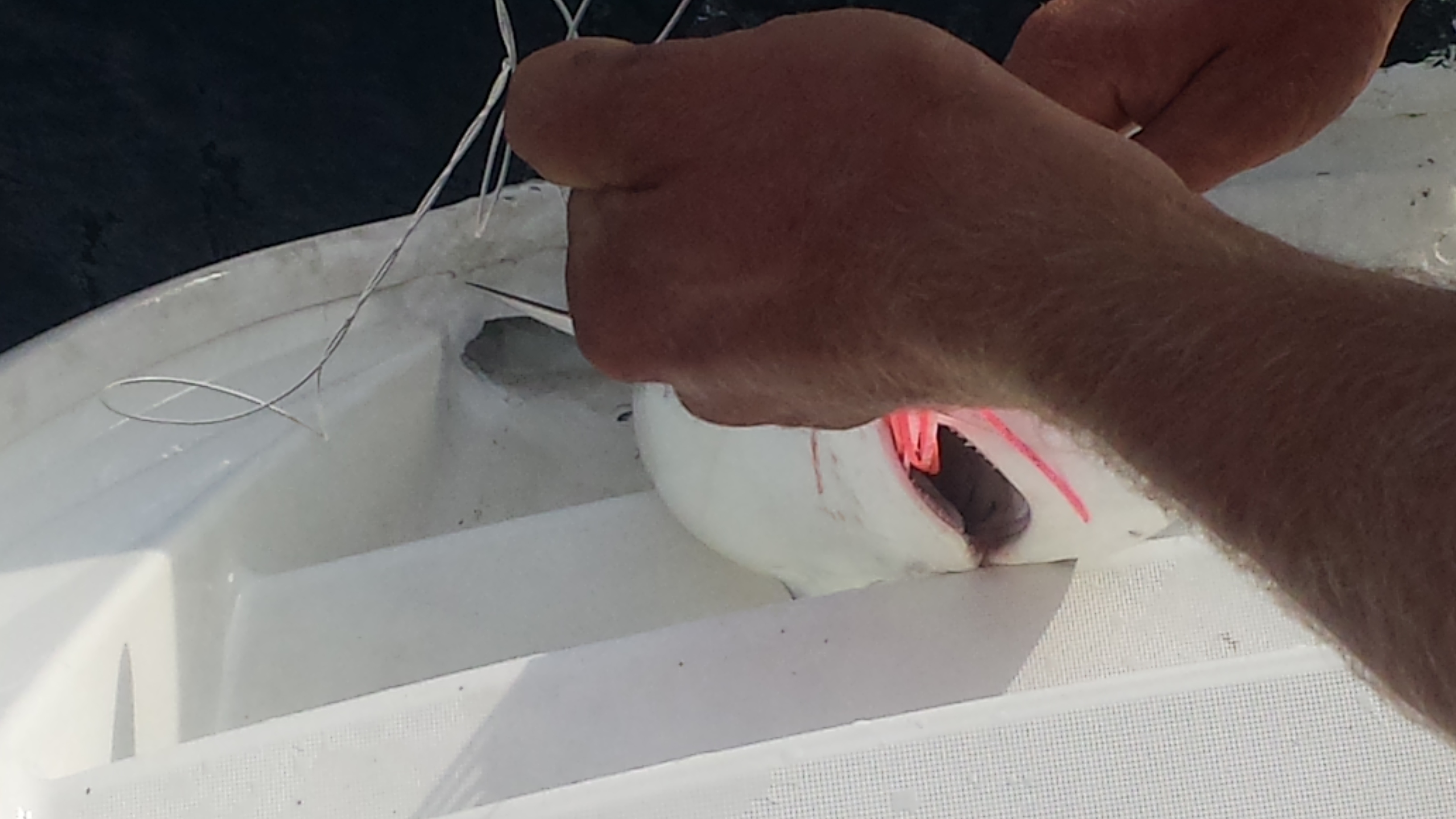
BZZZZZZZ  … The fishing lines screaming brought everyone together and back to the present.  I slowed the boat.  We drug the fish to tire it out.  I slowed a little more and we began gaining line on him.  But he was fighting and wasn’t jumping – which made me believe it was a Tuna or Barracuda.  I hoped for Tuna.  I could taste the Tuna steaks.  After dragging our prey behind the boat for a few minutes we caught sight of him in the wake.  Shark.  On a trolling lure?  Yep.  Bummer.  Not a huge shark, but no matter the size – it was a species we didn’t want to eat, which had a mouthful of dangerous teeth, and all of this would likely end in me loosing yet another fishing lure.  I got the shark to the sugar scoops and then he went apeshit.  The girls snapped pictures.  Then he swam away with my leader and my lure:  the line had snapped in my hand.  Rookie mistake.  I knew better than to hold him out of the water by the fishing line.  Well… Onward.


Our shark

Our shark


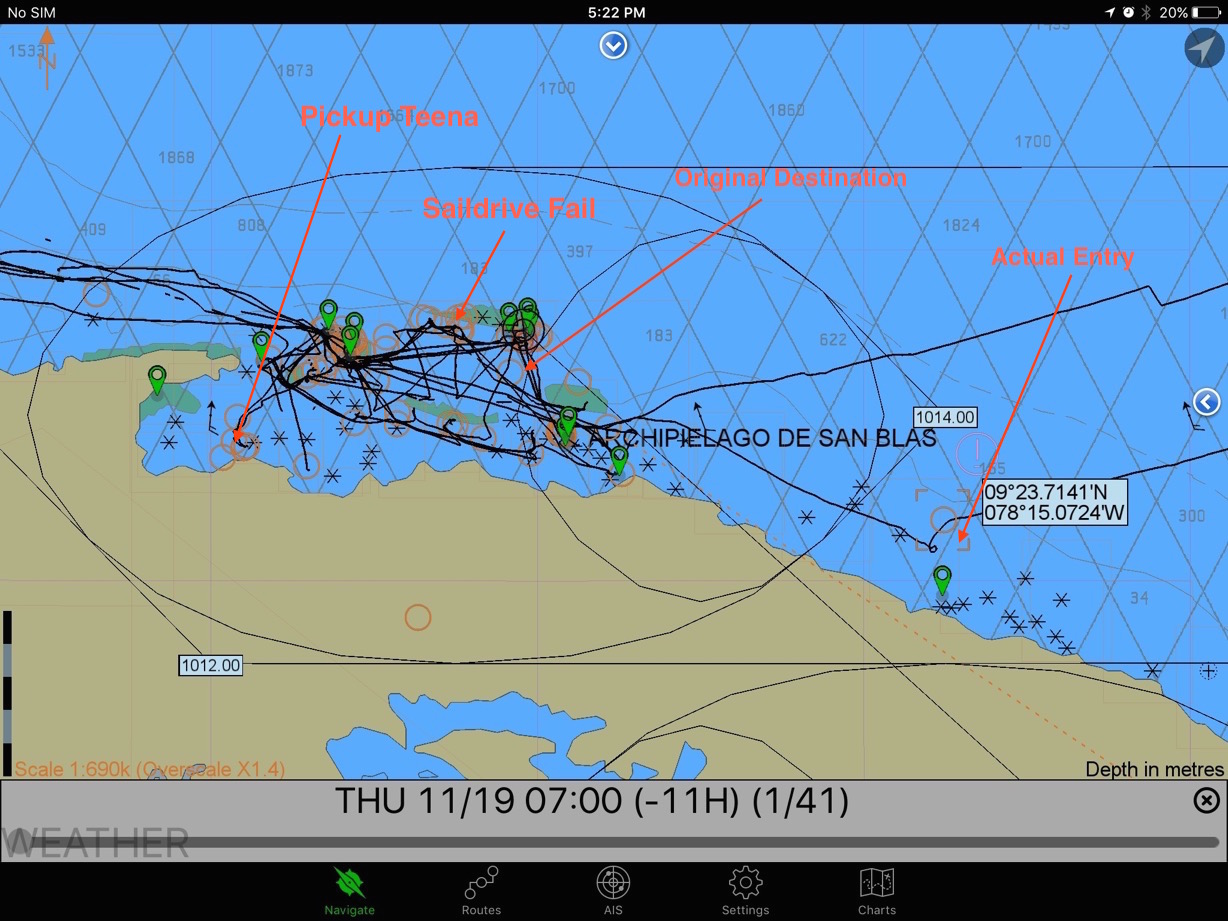
We needed to pick up another person in Western San Blas.  We decided to sail halfway there, then the remainder of the way the following morning.  I wanted to see some old friends – Mike and Laura on Gilana.  They were in their usual spot – Yansaladup.  It’s a tricky anchorage to get into, but it’s good practice for the girls – they need to be able to spot reef and direct me around it from the front of the boat.  Here’s some more geo-reference. 


San Blas!!

San Blas!!


As we entered the West Lemmons we were hailed by Sundowner (their website here:  Sundowner Sails Again) who had been chatting with me online for a couple months.  It was a half-surprise to bump into them. I got distracted chatting with them on the radio and nosed up very close to a reef, but I recovered without incident. 


We found a great spot to drop the anchor.  As we were letting out our anchor and chain I noticed that my starboard engine had died.  I tried to put the engine back into neutral and the throttle lever was stuck.  It wouldn’t budge.  Problem.


The Buzzkill


I didn’t have time to mess with it then.  But when we got anchored and secured, I nervously checked the Teleflex cables.  The cables were fine.  It was the damned saildrive.  Big problem.  It was seized and when I checked for oil (the same check I’d done just a few hours before) I found none on the dipstick.  Major problem.  Blown seal.  F*&$k.  


I immediately started pulling the sail drive apart.  When I did I found bronze shavings.  Lots of shavings and no oil.  Major bummer. This was going to be expensive.  This was going to take time.  This was not cool.  This is boat life.  


The point of going to this anchorage was to visit a friend and have a happy reunion before leaving to pick up Teena the following morning.  All of that shattered by this most recent discovery.  When I did finally see Mike and Laura I was sweating profusely, covered in grime, and a little worried.  Mike noticed quickly and after the “Hello, it’s been so long” ’s were exchanged we quickly got down to troubleshooting.  Mike told me he’d come and have a look, but to keep taking it apart. 


Back onboard the girls were a little bummed to hear of our latest mechanical failure, but their feeling of “that’s inconvenient” pales in comparison to the sinking feeling in the pit of my stomach.  This wasn’t going to be an easy fix.  And I had a guest coming. And I was stuck without any Internet access (to do research).  Water was being used at an alarming rate.  We did, though, have booze and good cheese.  If nothing else, we could attempt to drown our sorrows and eat away any lingering depression. 


That is a bit dramatic. 


The truth is that our passage was a success, we were anchored in a beautiful place near close friends and anything on this boat I was confident I could find a way to fix.  Almost anything.  Especially with Mike’s help (he’s a fix-stuff God).  Add to that the fact that I was being treated like a king by my new crew – and – well…  It can always be worse.  Always.


After a few hours of sweating and bleeding in the engine rooms Mike and I came to the conclusion this was a big project.  Nothing as simple as replacing a bolt.  We did find oil at the bottom of the drive, but it was clear that much had leaked out.  That means that my oil-seal  in the lower drive had blown out underway as no oil was in the engine rooms. 


I’ll post a picture of the offending part when I’m able – but it’s a sleeve that sits over the gears and serves to help select gears (Reverse – Neutral – Forward).  It’s toast.  Chewed up.  Destroyed.  We had no internet, but Mike found it was about $600 for the part – plus shipping.  And getting it out of the sail drive with the boat in the water wasn’t going to be easy.  We did find, though, that we could repair it without hauling the boat, a massive relief.  As long as this turns out to be the problem, I could be back in business within a month.  Until then, I’m a little crippled.


When all of this is over I will be well-versed in maneuvering tight (and reef-strewn) anchorages with a single engine.  


Because Mike and Laura are somewhat of a family, they helped organize getting Teena out to me in Yansaladup.  We had Mahi sushi and wine for dinner and slept well.


We would work things out mañana.


Mañana. 


San Blas!!

Sunday, November 22, 2015

Across the Blue

Not a huge crossing.  Enough, though. We made it. 


Naturally, the wind was in our face the whole time.  It was 36 hours of pure two-engine motoring.  I tried everything.  We tacked and the wind would shift.  We changed course and the wind would die.  For 36 hours the wind was our sworn enemy. Not just unhelpful, but downright antagonistic. 


But we made it.  There were dolphins.  There was a bit of on-the-way work in the engine rooms. Mahi.  Sushi for dinner and hot coffee always in the French Press.  Epic sunrises to start our days and epic sunsets that marked the beginning of the night shifts.  


Dolphins!

Dolphins!


Not too shabby…


I had to push the engines a little, just to keep us averaging 5 knots.  With the wind in our face and a bit of current working against us, it made forward progress seem impossible.The good news is that the engines kept their end of the bargain – except for a fuel-related issue (fungus in the damn fuel tanks again).  No issues to speak of, mechanically.  We also made enough energy to keep a second freezer cool, which allowed us to have ice, more meat, and ice-cold beer (for when we finally drop that anchor – it’s always a dry passage). 


The other Dolphin

The other Dolphin


Night motoring was easy.  No wind, no sailing, and nothing but long rolling swells.  Ana and I took shifts in the Captain’s Chair, I napped outside next to the cockpit.  Des kept us fed and happy and was nothing if not a pleasure to be around.  On passage we found that Des is our most serious fisherman, much moreso than me (or anybody else I’ve had onboard).  We drank lots of French-pressed Colombian coffee.  We trolled lines behind us and managed to pick up a Mahi, which we promptly made sushi out of.  Fresh sushi while on passage is a hell of a treat.  We had dolphins play up front and marveled at the deep blue of the ocean when the bottom is thousands of feet below you.  That color blue is impossible to recreate.  You can’t describe it.  And it’s impossible to counterfeit.


The Sushi Treat

The Sushi Treat


Rolling Sushi Underway

Rolling Sushi Underway


With all of our attempts to use the wind only to have the wind pushing against us, we lost time.  So rather than sail all the way across San Blas on our passage – I decided to cut our passage time a little and come into the Eastern end of San Blas while we had good light.  The change in course cut our passage by 20 or so nautical miles.  This gave us the chance to explore Cayos Raton, catch a good night’s sleep, and give the engines a break. 


Coming in

Coming in


Approaching Cayos Raton we were greeted by schools of Bonito that played and chased bait at our bow. The water was over a thousand feet deep until we were nearly on top of the island.  Then, suddenly, we were in a hundred feet of water.  Then we talked through our route into the reef-strewn San Blas islands so everyone was on the same page.  We went through our anchoring procedure in advance.


Then we decided that champagne was the only civilized way to celebrate the passage, and should be the last part of our anchoring procedure.  And, lucky for us, we had a bottle chilling in the freezer. 


When we came around the island, we saw a group of three other boats.  We had neighbors.  And it made the already small anchorage into a minuscule anchorage.  It was difficult to find a place to drop anchor without putting NOMAD in somebody’s face.  So we passed the marked anchorage and nosed into two or three holes – eventually finding a spot far away from the other yachts, and not close enough to the coral to be immediately dangerous. 


As we were nosing around, one of our neighbors greeted us in their dinghy.  A Canadian family.  Then their cruising buddy came up and said hi.  Then our neighbors left and we dropped anchor.  Before I even turned off our electronics – our neighbors were back.  They wanted info about Colombia, as they were headed to the place we were coming from.  I invited them for a beer later, but before the sun left us I needed to see Cayos Raton underwater.  From the charts, the underwater topography looked promising.   These charts are from Eric Bahaus, who produces the only charts for Panama.  His accuracy is impressive.  


Raton, charted

Raton, charted


The girls tidied up and dropped the dinghy while I shut down all the systems and got our diving gear out.  Twenty minutes later we were snorkeling around massive coral heads and I was missing my first fish in San Blas.  After the girls had a chance to look around we met back at the dinghy and moved closer to the steep reef wall we had skirted on our way in.  I knew it was a promising spot as soon as I saw it.  The reef went from about 30 feet to about 100 feet in a steep dropoff, studded by large coral heads and pocked by caves perfect for hiding snapper.


I was lucky.  On the first dive I caught sight of a small Dog Snapper at 30 feet.  I dropped down from the surface and glided down the reef wall toward him.  At 40 feet he stopped running down the wall and turned sideways – still well out of range.  And so I sat on the reef wall and began systematically relaxing muscles, waiting for his curiosity to work in my favor.  Like clockwork, the fish turned and approached me. One pass out of range.  The next in range.  Thunk.   The fish was now doing circles below me as I pulled us both toward the surface.  I was already planning my ceviche when I hit the surface.  Do we have avacado?  What about peppers?  We really need more fresh cilantro. 


At the dinghy, Des was waiting on me.  Since she was inside, I didn’t just toss the fish/spear/speargun into the dinghy – opting instead to take the fish off of the spear first so that the mess of steel and fish spines didn’t injure anybody.  That led to me the snapper going apeshit and escaping under a coral head and me letting out a long string of obscenities as I watched my hope of fresh ceviche disappear with my fish under a coral head.  We searched, but a smaller snapper like that is nearly impossible to find in the spiderweb of caves in the coral.  


My penance for losing a wounded fish is the end of my spearfishing for the day.  This was no exception.


We went back to the mothership and I dropped the girls onboard as I went to check our anchor underwater.  The anchor was far from set, but it was holding.  We only had one night here and I had both engines to get me out of trouble should it come – so I decided we were OK and climbed back onboard to find our new Canadian and American neighbors onboard.  They greeted me with a cold beer and I dried off as we exchanged information, swapped boat-maintenance headaches, and told stories.  Good whiskey was poured over small globes of ice as we made small and large talk with people who would have been good friends if we all weren’t parting ways with the sunrise.


The champagne came back out.


All was right in the world.


Across the Blue

Thursday, November 19, 2015

Long Time, No Post

Hello.  I’m Nate.  I’m sailing around Colombia on a Lagoon 380.  I used to update this site frequently.  I would ask your forgiveness for the tardy update, but I’m not good at asking for that. 


A coon’s age.  That’s how long it’s been since my last update. 


Long Time, No Post


Why haven’t I been writing here?  The truth?  I was busy.  I was working on the boat.  I was enjoying Cartagena.  I was tired of writing the same thing over and over.  Everyday was boat work.  Except the days that weren’t boat work.  Those days were fun.  On those days Kenny would swing by and tell me that he had a horrible problem and needed my help  most urgently. I would drop everything and come to his aid. Kenny had too many bikini-clad Colombian women and no guys on his boat, and he needed me to come and party with them in Cholon.  I would comply on those good days that weren’t boatwork.


And Now…


That’s all changed.  As I write this the sun is setting and we’re floating tranquilly in a bay with aqua-blue water that ends where the jungle begins.  The bay is stunning now, after the rain.  The birds are calling loudly.  The beer is very cold.  The air is cool and fresh. Tomorrow we sail to another country.  We’re leaving the country where they call me Gringo Dorado, going to the country where they call me Oso Dorado.  I’ll answer to either.  Nicknames are fun.


Cholon


We.  That’s right.  It’s no longer a one-man show.  I have a Brazilian Marine Biologist onboard.  She has an easy laugh and likes organizing things.  My boat is clean and organized and that makes me happy.  She swims more than anyone I’ve ever met.  She can wrestle a twisted anchor chain back onto the gypsy and doesn’t mind getting dirty.  Her name is Ana. 


There’s another girl onboard too.  She’s called Des (or Dez, maybe).  She’s from New York.  She’s a chef (SCORE!).  She likes wine as much as I do and we’ve had fun drinking too much of it.  She brought bagels and cream cheese and Boar’s Head ham to my boat and I can’t think of a better surprise.  She’s a gem.  Did I mention that she’s a chef?  Yeah.  We are eating well.  Every. Single. Meal.  Is.  Awesome.


Tomorrow our boat-family sails to Panama.  San Blas.  I want another shot at the Grouper there.  I want a few days of diving the outer reef at The Swimming Pool.  I want to sail and remind myself why I’ve been working in the Hellish heat of Cartagena for the last six months.  I want to have more of the good problems – too many fish, beers too early in the day, too many friends around, too much Rum the night before, too many reefs to dive.  Too much fun. 


We left Cartagena, likely my last time in that city, just a few hours ago.  I left nothing there, I took nothing with me.  Cartagena was a big part of my life.  Bigger than I expected.  It was so much fun.  It was so goddamn hot.  It was so loud.  It showed me some things about myself, some that I liked and some that I didn’t.  It made me happy to walk the streets.  I loved the Plaza at night, the women, the Aquadiente and the street food.  I loved our pizza place where they treated us like family. Cartagena made me curse the boat traffic. I detested the filthy water.  The lady that sold cheap (and delicious) lunch under the shade tree, outside of the marina, became something like my Colombian mother.  She made a special meal for me every day, in her personal tupperware and she labeled it “Gringo” – because there was only one gringo that ate there and it was this guy. 


We left Cartagena today and I was euphoric.  We left Cartagena today and it was sad.  I left two people that came to mean quite a bit to me.   They meant enough that it was impossible to tell them, but the words didn’t need to be spoken because the feeling was mutual and it was completely understood.  We left, they waved, they hugged, they wiped their eyes. I was so happy to leave. Euphoric.  I WAS FREE.


Just a Reminder


As if Poseidon himself were watching me leave, the sails were raised and immediately we were hit by a squall.  It came out of nowhere.  Suddenly we were caught in 25 knots of wind with full sails and the wind just kept getting stronger.  Sometimes it takes getting caught with your pants down to remind you that clothes have their purpose.  I got caught.  Consider me reminded.  There was an Oh-Shit moment, followed by some really fun sailing. I bled a little and some sails flapped too much and we hit 9 knots – despite having enough food to feed a small country, enough water to irrigate a small farm, enough booze to supply an aircraft carrier, and enough fuel to power a small country onboard. 


The Lost Time


What, pray tell, have I been up to?  Well. Shit…  Boatwork (so much that even typing that word turns my stomach).  My sister visited (randomly) and we sailed a bit and I was reminded how nice it is to have an intelligent and strong family.  I’m lucky, and that’s something I can’t deny.  I’ve been hanging out with Kenny, who has become a very close friend and who has been shockingly generous with his time and knowledge.  I’ve been hanging out with Fernando, who helps me on the boat and has also become a very close friend.  We spend time like most men do – complaining and joking about women, complaining and joking about how much bullshit you put up with when you buy a boat.  We eat together and laugh together and drink together.  I had a fling with a very talented singer at what might be the best bar in Cartagena.  I dove and fished and cooked and sweated and cursed and bled and lived. 


I lived fully in Cartagena and that is The Truth. But now that’s gone and tomorrow we cross an ocean and go to another country and place ourselves at the mercy of The Ocean, the only God that I continue to acknowledge. 


San Blas, it’s time to suit up.  Game time.  Two girls and one shaggy gringo are coming to rabble rouse.  We’ll be there soon. We’re planning many sushi dinners and many rum drinks.  We’ll see you soon San Blas.


Long Time, No Post

Saturday, September 26, 2015

Garmin GPSMap 741xs, GMR 18HD

I warned you – this is going to be a gear related post. If you’re not into boat-gear, this post might be the equivalent of reading an encyclopedia for enjoyment.  On the other hand, if you’ve been asking about what gear I use, here’s a gear post and you’re welcome. 


Garmin GPSMap 741xs, GMR 18HD 


So I found out my radar wasn’t simply disconnected, it was fried.  That’s an expensive discovery, so took a step back and wondered if I really needed a radar.  I tabled the decision for awhile while I talked to people and did research.  6 months later I decided I should have a radar for two main purposes: 1) at night, to be able to identify other boats on the water 2) to help identify land masses should I be navigating a strange place with sketchy charts and limited visibility.  At that point it came down to what radar.


What radar should I buy?


Great question.  Depends.  For me it was about a quality product, a low price, low power draw, color screen, and a radar range greater than 24NM.  Spoiler alert – there are few quality radars below $3,000.  The only one I found that seemed to meet my needs (and budget) was Garmin’s 741sx and GMR 18HD combo.  It’s a plotter/GPS/radar combo that can also read the bottom (it even supports CHIRP transducers) when you plug in a transducer.  Click here to see what CHIRP is.


Because of the price point and because I’ve had great luck with Garmin before – there was absolutely no competition.What really makes this unit a homerun, though, is that it does everything…


I have a simple Raymarine depth instrument.  That’s great for poking around anchorages and knowing how much scope to let out when I anchor.  But it’s not great for finding fish, seeing the composition of the bottom, or identifying reefs and wrecks on the bottom.  Being able to see a sonar image of the bottom is something I missed.  So a huge bonus to getting this Garmin unit was the ability to add a transducer for redundancy, but also to (finally) be able to see the bottom as a means to find fish and structure and dive sites.  A huge improvement. I didn’t go with a CHIRP system due to the expense – I don’t need the ability to see a grouper hanging over the bottom in 2000 feet of water (yet).


For navigation I currently use my iPad Air with SeaIQ and the CM93 charts.  The iPad is great (more on that later), but I wanted redundancy in GPS/chartplotting and it’s really nice to have a purpose-designed tool.  As if that wasn’t benefit enough, now I can overlay radar on charts and with a couple flicks of my fingers, watch the bottom in 2 different sonar frequencies. 


Finally, the unit talks to all of my other electrical doodads onboard.  It’s wired, through NMEA 0183 to my Standard Horizon GX2000 VHF.  It’s wired through NMEA 2000 to my Vesper Marine XB8000 AIS system. 


The unit itself is a small (relatively speaking) and handsome touchscreen.  It comes with the ability to flush-mount or gimbal it.  I chose to gimbal it, to avoid cutting big holes in my cockpit dash and to keep the screen closer to me (easier to see/use).  The menus are intuitive, in typical Garmin fashion, and the connections are all marine-grade – meaning they screw together and have O-rings that keep water out. 


GARMIN GPSMAP 741xs / GMR 18HD

GARMIN GPSMAP 741xs / GMR 18HD


When I purchased the unit, I purchased it as the radar/GPS combo (GPSMap 741sx and GMR 18HD), and then purchased the NMEA 2000 starter kit and the in-hull transducer separately.  Installing the radome itself was a PITA because I had to climb the mast in a rolling anchorage – but Garmin did us a HUGE favor by making the radome backwards-compatible with other 18” radome mounts – meaning my old Raymarine radar mount screwed directly into my new Garmin radome.  That’s something you don’t see very often, a round of applause to Garmin.


Installing the GPSMap 741sx was simple. Finding where to mount it was the hardest part.  The good news is that the 741sx has an internal GPS, a plug for an external GPS antennae, and it can pull GPS coordinates from other networked devices (for me, my Vesper XB8000 AIS).  So there was no reason to run another GPS antennae or pull more wire through the boat.   Here’s what the bottom of the anchorage looks like in CTG – split screen showing two sonar images, one in 50hz and another at 200hz.  


GARMIN GPSMAP 741xs / GMR 18HD

GARMIN GPSMAP 741xs / GMR 18HD


Connecting the NMEA 2000 and NMEA 0183 to the unit (to network everything) was remarkably simple.  I really appreciate the plug-and-play nature of NMEA 2000.  To run my NMEA 2000 network I simply needed to plug my Vesper Marine XB8000 and Garmin GPSMap 741sx into the NMEA 2000 backbone – and then run a power cable to the network.  Too easy.  NMEA 0183 was a little more hazy because I had to crimp wires and decipher diagrams from Standard Horizon and Garmin – but I managed to do it in under an hour. 


The transducer installation was trial and error.  I wanted the transducer as far front as possible, and I wanted it in the starboard hull (opposite my Raymarine transducer).  The design of my owner’s version Lagoon 380 made that difficult – but after a 1/2 day of playing with it we got it positioned in an acceptable spot.  To finish the installation of the transducer, we needed to grind the inside of the hull (below the waterline) to bare fiberglass, and then use 3M 5200 to attach the transducer housing.  At that point we simple let the 5200 cure, filled the housing with antifreeze, and plugged the transducer into the housing.  Not difficult at all, and it sure beats a thru-hull transducer which means hauling the boat out of the water to drill another hole under the waterline.


The biggest hurdle in the installation was mostly my fault – I needed more cable for both the radar data and for the transducer.  Of course, I installed this in Colombia, so it wasn’t as simple as walking to West Marine and picking it up.  It took a couple of weeks to get it here. 


With everything installed, hooked up, and powered on I couldn’t be happier.  For less than $2,5000 (all in), I have radar, a bottom-machine, and redundancy in depth/GPS instruments.  All on a color touch-screen that makes using it a pleasure.  Of course – the real test will come as I use the system over the next 5-10 years, but for now – all’s well. 


For smaller recreational boats, I can’t see the need for anything else.  Garmin’s 741sx does it all without sacrificing usability or breaking the bank.


Garmin GPSMap 741xs, GMR 18HD

Friday, September 25, 2015

Reality

It’s been kinda crazy around here.  Some work, some play.  My phone was stolen but it was in the middle of a night out;  I shared some fault in the ordeal. With no phone, I also have no internet access. And then, after I was without the phone for a couple of days, I realized how nice it is to be completely disconnected – so I decided not to spend money on a new one just yet.  The price of peace was my smartphone. 


But that’s not really worth writing about. 


Reality


If you’re one of those, here to be inspired – you might wanna skip the next month or so.  It’s still boat work.  The next month will be posts on gear and technical crap and me whining about the heat.  Of course, when I get real all the dreamers complain.  It goes like this:  Nate, you spend too much time talking about the boat, too much time talking about working on the boat, too much time talking about boat gear and installation.  Not enough time telling us about the dream.  Bullshit.   The dream turns out to be moments:  a sunset over an uncluttered horizon, a day of spearfishing fun, a daysail between two off-the-beaten path islands.  These dreamy moments stitched together with longer periods of challenge and hard work.  


Speaking to other folks that have prepared for similar voyages – the common thread is that preparation is two people working on the boat, full-time, for a year before they complete the refit.  Read that again:  it usually takes a year of full-time, unpaid, strenuous work to get a boat like this ready.  Some folks took two years, if they did it all alone.  Some it took a little less.   The cost of the boat is hardly the price of admission, it will amount to a single line item on a long receipt.  Don’t forget to count the blood and sweat and tears and countless hours and endless gear purchases – all following the purchase of the boat. 


So that’s the reality – this shit is technical sometimes.  This shit is dirty and sweaty sometimes.  This is about knowing what gear to buy, how to install it, and where to source it as well as (sometimes more than) sailing.  It’s about what spares to have onboard.  It takes tons of work to get set up for big crossings and sailing in remote locations.  Every time somebody tells me I’m living the dream, I can look down at greasy hands and filthy clothes and wonder what strange dreams they heave.  But any dream takes work. 


Since we’re being real today, let’s talk money.  It costs real money to buy this kind of boat.  It costs real money to refit this kind of boat.  It costs real money to sail and maintain this kind of boat. Defender.com doesn’t take IOU’s.  I tried to convince both the grocery store and the marina that they should let me pay with pocket lint.  The guys at the diesel dock just said “No entiendo” when I told them that I needed diesel but that I didn’t have money.  When I have to pay for visas, the officials become sullen when I explain that I’m paying with my goodwill.  


About as often as somebody tells me I’m living the dream, I get a request from a stranger to come onboard… (wait for it) …without any money. They want to come and sail with me, without paying for the place they sleep or what they eat or what they drink.  It’s like standing in line at a theme park without having the money for admission.  In short, it’s foolish.  They say they’ve always dreamed of sailing around the world – as if their dream is an established currency in their dream world.  I’ve taken two people without money onboard – one stole thousands of dollars from me and the other added money-problems to my already long list of things to think about.  Fooled me twice, shame on me.


The dreams of so many people are so far removed from reality.  You learn, as time passes, why harbors and boatyards are stocked full of derelict boats. Unfinished projects serving as gravestones marking the harsh reality behind the facade of idealistic dreams. 


You can do this with less money but not at this level.  You can do this with less work but you better be able to cash that check.  That’s the reality.  It’s not as shiny as the dream.


The Last Month in CTG


Back to the present. 


When I first got back to the boat it was with great relief.  The States just isn’t home anymore – the language of job worries and commuting and mortgages and weddings and insurance and baby showers is now foreign.  The longer that is foreign, the better I’ll feel.  Back in CTG I had a week to get stuff settled.  A week to decompress and prepare for a visit from a friend.


Look how nice the water is...

Look how nice the water is…


Said friend visited from the States and we took a short trip to the Rosarios.  A trip to Cholon, lots of rum, late mornings and long nights.  She left.  Then it was singers at bars and drama at beaches.  Then it was back to boatwork.  Weeks of sweating and bleeding and cursing boats in general.  The heat oppressing, we pray for cloudy days that rarely manifest.   A moment of humor and clarity – yesterday when I went to the dock I received a standing ovation:  it was the first time they’d seen me clean in months.  This work is dirty.


The good news is that I accomplished a fair amount.  I’ll start in the engine rooms. 


There was a final repainting of the engines.  This is my third shot at painting the damn things in the last year. The first time I used a Volvo Penta paint, assuming it would be a quality paint.  It was not and it began flaking and rusting within three months.  The next shot at painting the engines I used this stuff:


Engine Paint Fail

Engine Paint Fail


Word to the wise:  don’t use that stuff.  It may be good for high-temp, light-duty stuff.  It is certainly not good for heavy-duty or marine use.  Rubbing that paint with a soapy rag removed the paint.  So about two months after the application of that paint, I decided to scrub and scrape it off the engines again.  A-freaking-gain.  


I reckon the third time’s the charm. 


The third time around I vowed to never, ever use a single-part paint on the boat again – at least not on anything I care about.  Single part paints just don’t cut it.  Single-part paints are for hobbyists.  This time around I wanted an epoxy-based paint.  The epoxy-based paints adhere well and provide a heavy-duty barrier that prevents corrosion.  Unfortunately epoxy-based paints don’t do very well in high-heat applications.  But with a bit of searching I found a local, epoxy-based paint that tolerated heat – a two part paint of course.


So we spent another two days on each engine – scraping and cleaning and repainting in The Sauna (the engine rooms).  Eventually we got it done.  Then we needed to replace the sound barrier in the engine rooms.  I searched and searched and finally found what I wanted – in the States.  Getting it here would be a problem though.  The cost and trouble of getting my hands on it, though, bordered on ridiculous. 


So.  I made the damn soundproofing.  It’s two parts:  one piece of a heavy lead or rubber sheeting that serves to absorb the sound/vibration and another piece of mylar-coated insulation.  Lead sheeting was near-impossible to find here, but I found a heavy rubber (gasket material) that turned out to be a great substitute.  The process sounds simple, but it took a week.  We  removed everything mounted on the bulkhead, cleaned the surface, glued the two parts together, cut it, fit it, glued it to the bulkhead, and then sealed all the edges with the right tape.  It turned out well and it cost a fifth of the commercially available products Stateside.  The real investment was time.  You can see the result, behind the fuel filter below. 


Griffin Filters

Griffin Filters


Next up was replacing my old-school Racor fuel filters with the turbine fuel filters from Griffin.  I opted to go with Griffin over Racor based solely on price.  In the words of a good friend:  Racor’s not the only game in town.  For the price of one turbine Racor fuel filter I got two Griffin’s from John at dieselfitlersdirect.com.  For any and all fuel filter needs, these are my guys.  I added the vacuum gauges on top as a means of telling when I should replace the filters.  The vacuum gauges are a nice-to-have, not a must-have.  The turbine filters are a big upgrade over the twist-on Racors that I replaced, if only for ease of replacing the filter cartridge.  In addition I picked up 36 fuel filter cartridges – 36 of the new cartridges cost less than 6 of the old and occupy less space as well.  With freshly cleaned fuel tanks (and new inspection ports), properly treated fuel, and the new fuel-filtration system – I think the majority of my fuel problems are in the rearview. 


And that’s enough for today. 


Next up is the radar/transducer/GPS system installation.  New toys.  It’s just money, right?


Reality